Should outdoor living areas, pools, and landscape lighting run on the same automation system?
Outdoor zones behave nothing like interior rooms, yet owners expect one app and one set of scenes. Here is how experienced integrators decide what to unify and what to leave on its own controller.
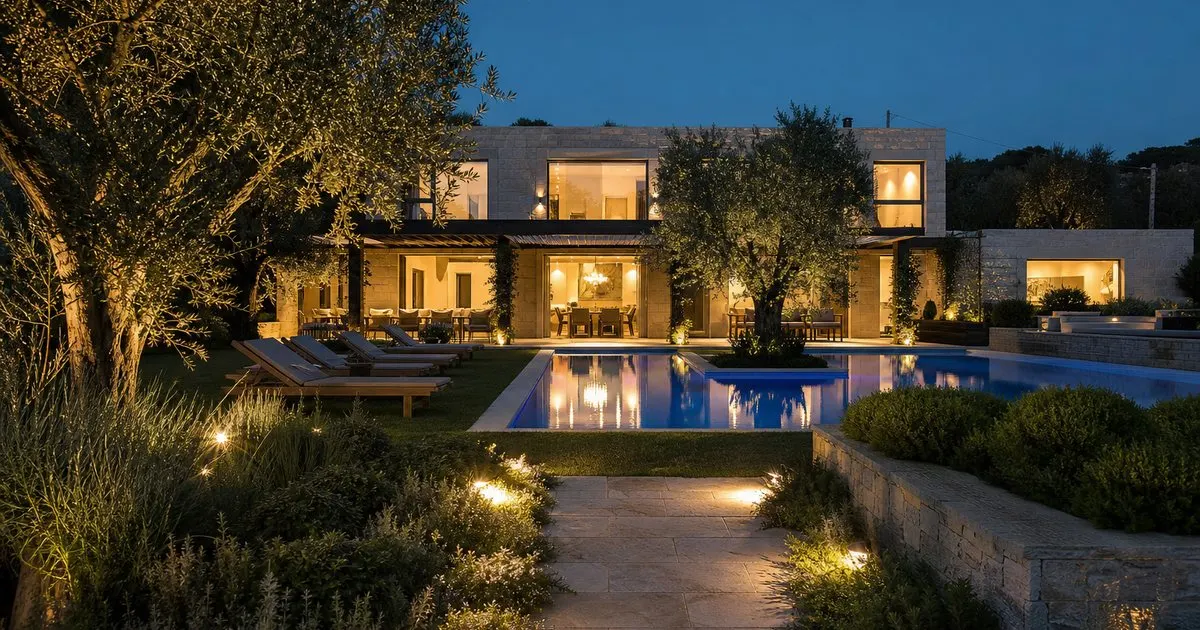
Why the exterior is a different design problem
The exterior of a large residence is rarely a single zone. A typical scope includes facade and landscape lighting, path and step lights, a pool and spa with their own pumps and heaters, irrigation, driveway gates and intercom, exterior cameras, outdoor audio, patio heaters and fire features, motorized screens or pergola louvers, and often a pool house or guest cottage with a small system of its own. Each of those was specified by a different trade, on a different schedule, and frequently installed after the interior was finished. That sequence, more than any technical limit, is why outdoor control so often ends up as a drawer of separate remotes and a phone full of unrelated apps. Related: How do you plan luxury whole-home automation for a large private residence?
The deeper issue is that outdoor equipment carries responsibilities interior equipment does not. Pool controllers manage pump speed, sanitization, and freeze protection with safety interlocks. Irrigation controllers deal with rain sensors and, in many communities, local watering restrictions. Gate operators have obstruction detection and emergency release requirements. None of that logic should be reinvented inside a home automation processor, and a good integrator will refuse to try. The realistic goal is a single coherent experience layered over systems that keep their own brains, not one platform that literally runs everything outside. Related: What core systems should a premium smart home integration genuinely prioritize first?
Keep reading: How do you plan luxury whole-home automation for a large private residence?, What core systems should a premium smart home integration genuinely prioritize first?, Which control interfaces work best for an intuitive luxury whole-home automation experience?. See how Smarthausr helps you an expert guide to whole-home luxury automation.
One system for control, several for equipment
In practice the strongest outdoor designs leave the specialist controllers in place and integrate them at the control layer. The automation processor asks the pool controller to raise spa temperature or start the waterfall, asks the irrigation controller to skip a cycle, and displays gate and camera status, while the underlying equipment continues to enforce its own safety rules. Integration depth varies enormously by product category, so verify it before anything is ordered. Ask the integrator to name the specific driver, confirm that it is two-way so status comes back rather than commands only going out, and confirm whether it runs locally or depends on a manufacturer cloud service that can change or disappear. Related: Which control interfaces work best for an intuitive luxury whole-home automation experience?
Lighting is the exception worth centralizing outright. Landscape and facade lighting behaves like interior lighting, benefits from the same dimming curves and scene logic, and should generally live on the same lighting control system as the house so an evening scene can cross the threshold without a handoff between platforms. Low voltage fixtures need drivers that dim smoothly at the bottom of the range; a fixture that flickers or drops out near ten percent will spoil an otherwise elegant scene, and the fault is usually the driver rather than the lamp. Ask to see a night mockup on the actual dimming platform, in the actual planting bed, before the order is placed.
Infrastructure decides what is possible later
Outdoor reliability is settled in the trenches, long before any programming. Conduit under driveways, terraces, and lawns is the single most valuable thing to install early, because adding a cable afterward means cutting hardscape that took weeks to lay. Run more conduit than the current design calls for, sleeve every crossing under paving, and terminate spare runs in weatherproof boxes at the pool equipment pad, the gate, each outbuilding, and the far corners of the property. Long low voltage runs also need larger conductors than interior work to control voltage drop, which is a common and easily avoided cause of dim or color-shifted fixtures at the end of a circuit.
Assume that wireless will not carry a large property. Wet foliage, stone walls, and simple distance defeat consumer mesh networks well before the property line, so exterior access points, cameras, and gate equipment deserve wired network drops using outdoor-rated cable in conduit, with surge protection where a run leaves or re-enters a building. Long exterior copper runs are a genuine surge path back into the equipment room, and fiber between the main house and an outbuilding removes both that risk and any distance limit. Enclosures should be rated for their location, mounted so water drains away, and shaded from direct afternoon sun, which quietly shortens the life of everything inside. Related: Why does wired infrastructure still matter in a high-end smart home system?
The daily experience: scenes, seasons, and upkeep
Good outdoor programming is mostly a matter of time and restraint. An astronomic clock that tracks sunset through the year keeps facade and path lighting honest without seasonal fiddling, ideally stepping down to a quiet security level late at night rather than shutting off entirely. Fire features, heaters, and pool heat suit arrival triggers better than fixed schedules, since a gate code or an estimated arrival time can bring the spa to temperature before guests reach the house. Outdoor audio deserves per zone volume limits, particularly where sound carries to neighbors, and one button that quiets the entire exterior at a set hour proves far more useful than an elaborate playlist.
Plan for the calendar and for service visits. Freeze protection, seasonal shutdown, and pool cover routines belong in written documentation rather than in the integrator's memory, and any automation able to start a pump or a heater needs an obvious manual override at the equipment pad for the pool technician and the landscaper. Fixtures set into planting beds disappear behind growth within a season or two, so schedule an annual aiming and cleaning visit alongside the automation service agreement. Expect exterior hardware to age faster than interior hardware, and budget for replacing exposed fixtures, gaskets, and enclosures across the life of the system rather than treating them as permanent.
- Unify the control experience, not the equipment: keep pool, irrigation, and gate controllers native and integrate them for scenes and status.
- Put landscape and facade lighting on the same lighting platform as the interior so evening scenes cross the threshold cleanly.
- Conduit, spare cable, heavier conductors, and wired network drops determine what the exterior can do five years from now.
- Program to sunset and to arrival rather than to fixed clock times, and document seasonal routines with a manual override at the pad.

Julien Jimenez
Julien Jimenez is an independent software builder based in Paris. He designs, ships, and operates focused SaaS products for small businesses and independent professionals. Read the full author page.
A Home That Anticipates You
An expert guide to whole-home luxury automation. Smarthausr is built to help you put this into practice.
Plan your homeMore from the Smarthausr blog
How do you plan luxury whole-home automation for a large private residence?
What core systems should a premium smart home integration genuinely prioritize first?
Which control interfaces work best for an intuitive luxury whole-home automation experience?
Get the complete luxury whole-home automation guide
Our full buying guide, the price guide, and new research as we publish it. One email, no spam, unsubscribe any time.