How much should you budget for motorized shading within a whole-home automation project?
Motorized shading is one of the most visible upgrades in an automated residence, and one of the easiest to underestimate. Here is how the costs actually stack up and where the money goes.
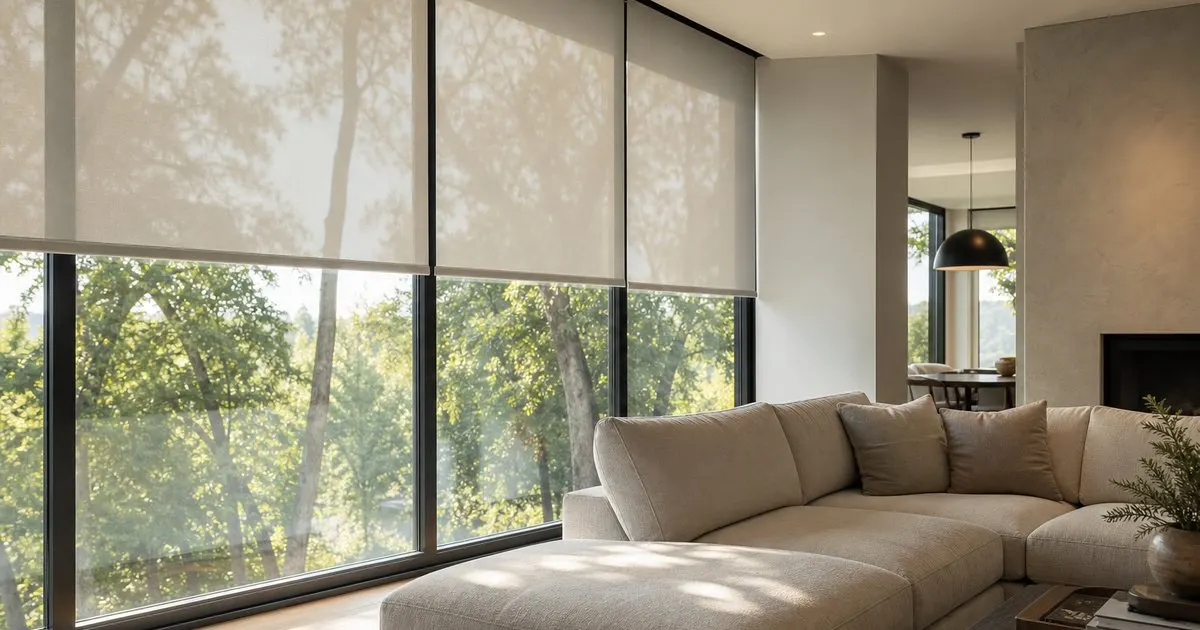
What actually drives the price of a motorized shade
A motorized shade is priced per opening, and the opening itself sets the baseline. Width, drop, and whether the window is a standard rectangle or an arch, a corner, or a skylight all change the fabric yardage, the tube diameter, and the motor torque required. A modest bedroom window and a twelve-foot great room wall may share a fabric, but they will not share a price. Fabric is the second lever: a basic solar screen sits at one end, and a blackout, a dual roller combining sheer and blackout, or a hand-finished Roman treatment sits at the other, often multiplying the cost of the same opening two or three times over.
The motor and its power source matter more than most buyers expect. Battery motors are the least expensive to install because they need no wiring, but they trade that convenience for periodic recharging and, on large or heavy shades, limited torque. Low-voltage wired motors need a home run to a power supply and are typically the right choice for a new build or a full renovation. Line-voltage motors handle the largest and heaviest treatments. Each option carries a different labor profile, and labor, not hardware, is frequently the line that surprises people on the final invoice. Related: Why does wired infrastructure still matter in a high-end smart home system?
Keep reading: How do you plan luxury whole-home automation for a large private residence?, What core systems should a premium smart home integration genuinely prioritize first?, Which control interfaces work best for an intuitive luxury whole-home automation experience?. See how Smarthausr helps you an expert guide to whole-home luxury automation.
Realistic ranges for a luxury residence
For a whole-home project, it is more useful to think in terms of a per-opening range than a single headline number. In our experience reviewing quotes, a well-specified wired roller shade in a quality fabric, installed and integrated, typically lands in the high hundreds to low thousands of dollars per standard window, and climbs from there as size, fabric, and custom shapes enter the picture. A home with thirty to fifty openings can therefore move from the tens of thousands into six figures without anyone making an extravagant choice, simply by scaling ordinary decisions across many windows. Related: Which control interfaces work best for an intuitive luxury whole-home automation experience?
The honest way to build a budget is to walk the house room by room and assign a tier to every opening: essential (bedrooms, media rooms, west-facing glass), desirable (living areas where sun control affects comfort), and optional (secondary rooms and small windows). Price the essential tier first at the quality you actually want. It is far better to motorize twenty openings properly than fifty cheaply, and a good dealer will help you phase the rest without leaving stranded wiring.
Integration costs people forget to include
Shades do not integrate themselves. Connecting them to a whole-home control platform requires a gateway or a shade controller, programming time, and often a licensing fee tied to the control processor. Each shade needs to be addressed, grouped, and assigned to scenes such as a morning rise, a midday sun-tracking position, and an evening privacy setting. That programming labor is billed by the hour, and a thoughtful scene library for a large home takes days, not hours, to build and refine. Related: How do you plan luxury whole-home automation for a large private residence?
Power supplies, wire, conduit for future pulls, and the electrician's time to place outlets or low-voltage junction boxes behind each header all belong in the shading line even though they may appear on another trade's invoice. If the window package is being installed at the same time, coordinate the pocket dimensions early; a recessed shade pocket that hides the roller costs little to frame during construction and a great deal to retrofit afterward.
Where it is sensible to spend and where it is not
Spend on fabric in rooms where the shade is seen closed for hours each day, on quiet motors in bedrooms, and on dual-roller or layered treatments where both daylight control and full privacy matter. Spend on a proper wired power scheme anywhere the house is opened to the studs; the marginal cost is small and it removes battery maintenance for good. Spend on sun-tracking or astronomical clock programming, which is what turns a set of shades into a system that quietly manages glare and heat gain without anyone touching a keypad. Related: What ongoing support should you expect after installing a premium home automation system?
Be more skeptical of exotic control add-ons, oversized motors on small windows, and premium fabrics in utility spaces. Also be clear-eyed about affiliate and dealer incentives: many shading lines are sold through authorized dealers who earn margins that vary by brand, and independent guides like this one may earn a commission on some referrals. None of that changes the physics of a window, so anchor your decisions on opening size, fabric performance, and power, and treat the rest as negotiable.
- Price motorized shading per opening, driven by size, fabric, and motor type, not by a single house-wide figure.
- Wired low-voltage motors cost more to install but eliminate battery maintenance for the life of the shade.
- Integration, programming, and electrical prep are real costs that often sit on other trades' invoices.
- Tier every opening as essential, desirable, or optional, and fund the essential tier at full quality first.

Julien Jimenez
Julien Jimenez is an independent software builder based in Paris. He designs, ships, and operates focused SaaS products for small businesses and independent professionals. Read the full author page.
A Home That Anticipates You
An expert guide to whole-home luxury automation. Smarthausr is built to help you put this into practice.
Plan your homeMore from the Smarthausr blog
How do you plan luxury whole-home automation for a large private residence?
What core systems should a premium smart home integration genuinely prioritize first?
Which control interfaces work best for an intuitive luxury whole-home automation experience?
Get the complete luxury whole-home automation guide
Our full buying guide, the price guide, and new research as we publish it. One email, no spam, unsubscribe any time.